
No. 08 — The field manual · Nine chapters
Women's Dress Styling Guide
A practical handbook on how to style a dress — necklines, sleeves, dress lengths, colour, footwear, accessories and layering — written for real days in Mumbai, from humid errands to late dinners.
- Format
- Field manual
- Chapters
- 01 — 09
- Diagrams
- 18 icons, 1 figure
Styling is the part of dressing that happens after the dress is chosen. The same garment can look entirely different depending on what sits at the neck, the wrist, the feet and the shoulders — and on how those pieces relate to the dress's own lines.
This dress styling guide is organised like a workshop manual: each chapter isolates one variable, explains how it changes the overall picture and gives practical combinations you can try the next time you get dressed. Nothing here is a rule about who may wear what. We talk about line, proportion, balance and movement — tools you can use with any dress you already own. For the shapes themselves, the silhouette atlas of dress styles is the best companion; for cloth, turn to the material library of fabrics and details.
Neckline guide — framing the face
The neckline is the first thing anyone reads when they look at you, because it sits closest to the face. It sets the shape of the space between chin and bust, and everything you add there — necklaces, scarves, collars, hair — either works with that shape or argues against it. A useful habit: look at the neckline as a frame, then ask what the frame needs. Some need a centrepiece; many need nothing at all.
The diagrams below show the eight necklines you will meet most often. Dashed lines mark the neck and shoulders; the solid line is the dress.
Going deeper: Understanding Dress Necklines and Sleeve Designs in the Style Journal.
Sleeve guide — shoulder to wrist
If the neckline frames the face, the sleeve sets the width of the upper body and decides where the eye stops along the arm. A sleeve that ends at a point of interest — the wrist, the elbow, the shoulder — draws attention to that point; a sleeve with volume adds weight to the top half of the silhouette, which then needs balance somewhere below, usually through a defined waist or a simpler skirt.
Sleeves also dictate what else you can wear. A bell sleeve leaves no room for bracelets; a sleeveless dress invites a jacket. Practical comfort matters too: in Mumbai's warmer months, flutter and short sleeves let air move, while three-quarter sleeves offer cover from sun without heat. Read each sleeve as a decision about where you want the line to break.
Dress length guide — where the hem lands
Hem length changes the proportion of an outfit more than any other single detail. It decides how much leg is visible, which shoes look right, how the dress moves when you walk and climb stairs, and which occasions it suits. The figure maps the five standard dress lengths against the body.
- 01 Short
- Above the knee, usually around mid-thigh. Short dresses put the focus on shape and on the legs, so footwear matters: trainers make them casual, heels make them festive. Balance a short hem with more coverage at the top — a sleeve or a higher neckline — when you want a polished day look.
- 02 Knee-length
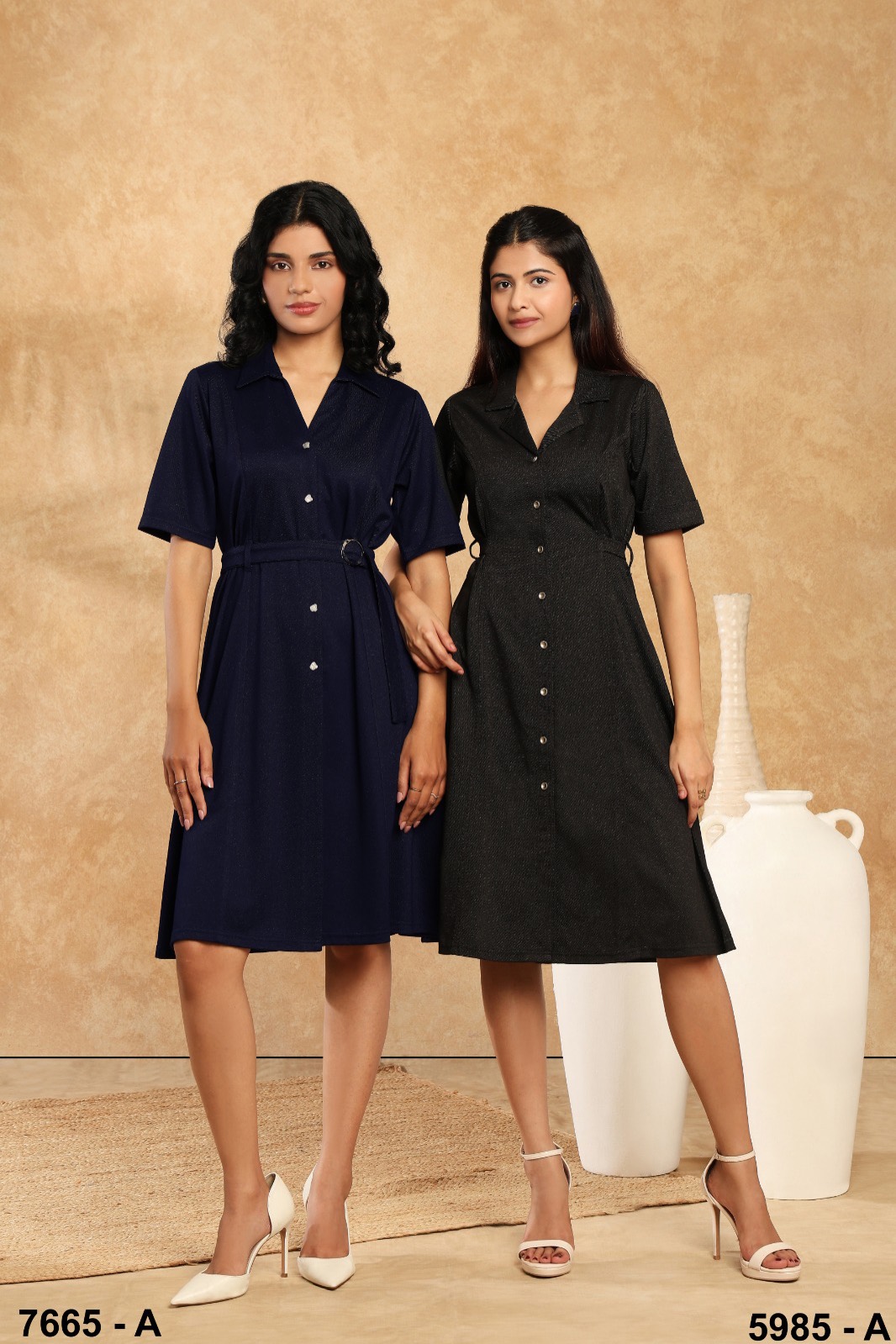
- The classic office and daytime length, as in the shirt dresses on Plate A. It is easy to walk in, works with almost every shoe and reads as tidy without trying. A belt at the waist sharpens it; a cardigan softens it.
- 03 Midi
- Mid-calf, and the most adaptable length in a wardrobe. The hem moves when you walk, which gives even simple dresses some grace. Midis look best with shoes that either show the ankle (strappy sandals, pumps) or commit to cover (ankle boots in cooler months).
- 04 Tea-length
- Falls between mid-calf and ankle. Historically associated with afternoon gatherings, it feels slightly formal and pairs well with full skirts and fit-and-flare shapes. Choose delicate footwear — a slim strap or a low heel — so the small gap of ankle stays light.
- 05 Maxi
- Ankle to floor, an unbroken vertical line. Maxis feel relaxed in printed cotton and dramatic in satin. Check the hem with the shoes you will actually wear; a maxi that drags on wet monsoon pavements is no pleasure. Flats or wedges suit day maxis; heels lift evening ones.
Colour coordination — proportion over rules
Colour coordination is less about finding a correct combination than about deciding how much of each colour you use. One colour should lead, a second should support it, and anything else should appear in small, deliberate quantities. A widely used rule of thumb divides an outfit roughly into sixty, thirty and ten per cent — the dress, the second layer or shoes, and an accent. Treat it as a starting point rather than arithmetic.
The strips below show five approaches using the colours of this site. Each bar is an outfit: read the widths as proportions.
-
Porcelain 50% Stone grey 30% Carbon 20%
Neutrals
Neutrals are colours that sit quietly beside almost anything: whites, creams, greys, browns, navy and black. A neutral dress is the easiest canvas for accessories, and an all-neutral outfit looks calm and expensive when the textures differ — a crisp cotton dress with a soft knit and leather shoes.
-
Carbon 50% Porcelain 50%
Contrast
High contrast pairs a dark and a light colour in near-equal measure. It is graphic and decisive — think of a black shirt dress with white trainers, or navy with ivory. Contrast draws the eye to edges, so make sure the edges you create (a hem, a belt, a shoe line) are the ones you want noticed.
-
Rose 40% Peach 35% Cocoa 25%
Monochromatic
A monochromatic or tonal look uses one colour family in several depths: blush with peach and a deeper brown, or sky blue with denim and navy. It creates a long, unbroken line and looks considered without effort. Vary the texture so the tones stay distinct.
-
Stone grey 60% Carbon 30% Chartreuse 10%
Accent colour
An accent is a small dose of a bright or unexpected colour against a quieter base. One accent is plenty: a lime bag, a red lip, a turquoise earring. Repeating the accent once — bag and shoe, say — can tie a look together; repeating it three times usually turns it into a theme.
-
Cocoa 45% Stone grey 35% Peach 20%
Colour combinations
Combining two or more distinct colours is easiest when they share an undertone or a depth. Warm brown with a cool grey works because both are muted; add a soft third colour to bridge them. When a dress is printed, pull your accessory colours from the print itself — the safest combination is the one the designer already chose.
For printed dresses and seasonal palettes, read Colour Coordination in Women's Fashion: A Practical Guide.
Fabric and styling — let the cloth decide
Fabric sets the register of a dress before colour or cut. Texture tells you how formal it is; drape tells you how it moves and therefore what can sit on top of it. A simple principle runs through all good styling: match weights and contrast surfaces. Heavy accessories overwhelm fluid fabrics, and very delicate ones disappear against chunky textures. Meanwhile, a matte dress welcomes a little shine, and a shiny dress is calmed by something matte.
- Crisp cotton & linenHolds its shape, creases honestly, reads as daytime.
- Canvas or leather totes, wooden or resin jewellery, trainers, loafers and flat sandals. Layer with denim or a light blazer; roll the sleeves. Embrace a little crumple rather than fighting it.
- Fluid georgette & chiffonLight, airy, moves with every step.
- Fine chains, small drops and slim straps. Avoid stiff, heavy bags that crush the drape. Layer with something equally soft — a kimono or a fine knit — rather than a structured jacket.
- Satin & silky finishesReflects light, shows every line, reads as evening.
- Matte contrast: suede or leather sandals, a textured clutch, metal jewellery with a brushed finish. Keep one shiny element — the dress — and let everything else sit back.
- CrepeGrainy, matte, with a weighty fall.
- The most versatile surface. Polished metals, structured handbags and pointed shoes sharpen it for work; strappy heels and drop earrings turn it towards evening.
- Textured weaves & knitsJacquard, slub, crinkle, smocking — surface interest built in.
- Simplify the accessories so texture leads. One substantial piece of jewellery, plain leather shoes, a bag without hardware or pattern.
- Denim & chambraySturdy, casual, softens with wear.
- Trainers, espadrilles and ankle boots; woven bags; silver or beaded jewellery. A denim dress layered with a denim jacket works best when the two washes are clearly different.
When in doubt, lay the accessories on top of the dress before you put it on. If the necklace looks heavier than the fabric under it, or the bag's hardware glitters more than a matte dress can carry, swap one piece. The fabrics and construction library explains each cloth in more depth.
Footwear coordination — by length & hour
Shoes complete the line that the hem begins. The rule of proportion is simple: the shorter the dress, the more freedom you have with footwear; the longer the dress, the more the shoe needs to suit the hem. Weight matters as much as style. Chunky soles balance thick fabrics and short, structured shapes; slim straps and pointed toes suit fluid fabrics and longer hems. Occasion then narrows the choice. Use the table as a starting grid.
| Length | Everyday | Work & daytime events | Party & evening |
|---|---|---|---|
| Short | White trainers, flat sandals | Loafers, low block heels | Strappy heels, pointed mules |
| Knee-length | Trainers, espadrilles | Pointed flats, classic pumps | Ankle-strap sandals, slim heels |
| Midi | Slides, flat sandals, clean trainers | Slingbacks, low block heels | Strappy or barely-there heels |
| Tea-length | Ballet flats, low sandals | Kitten heels, slingbacks | Delicate heeled sandals |
| Maxi | Flat sandals, wedges | Platform or block sandals | Heels hidden or just visible at the hem |
Two practical notes. First, shoe colour: a shoe close to your own skin tone or to the dress extends the line of the leg, while a contrasting shoe stops it — both are useful, depending on the effect you want. Second, comfort: if you will stand for hours at a function, a block heel or wedge carries the same polish as a stiletto. For dressing by event, see the guide to occasion and celebration dresses.
Accessories — the punctuation
Accessories are punctuation: they pause, emphasise and close a sentence the dress has already begun. The skill lies in choosing one focal point and letting everything else support it.
Jewellery
Start at the neckline (chapter 01) and work outward. If the earrings are bold, keep the neck bare; if the necklace leads, choose studs. Match metal tones within an outfit unless mixing is deliberate and repeated. Printed dresses usually want less jewellery than plain ones.
Handbags
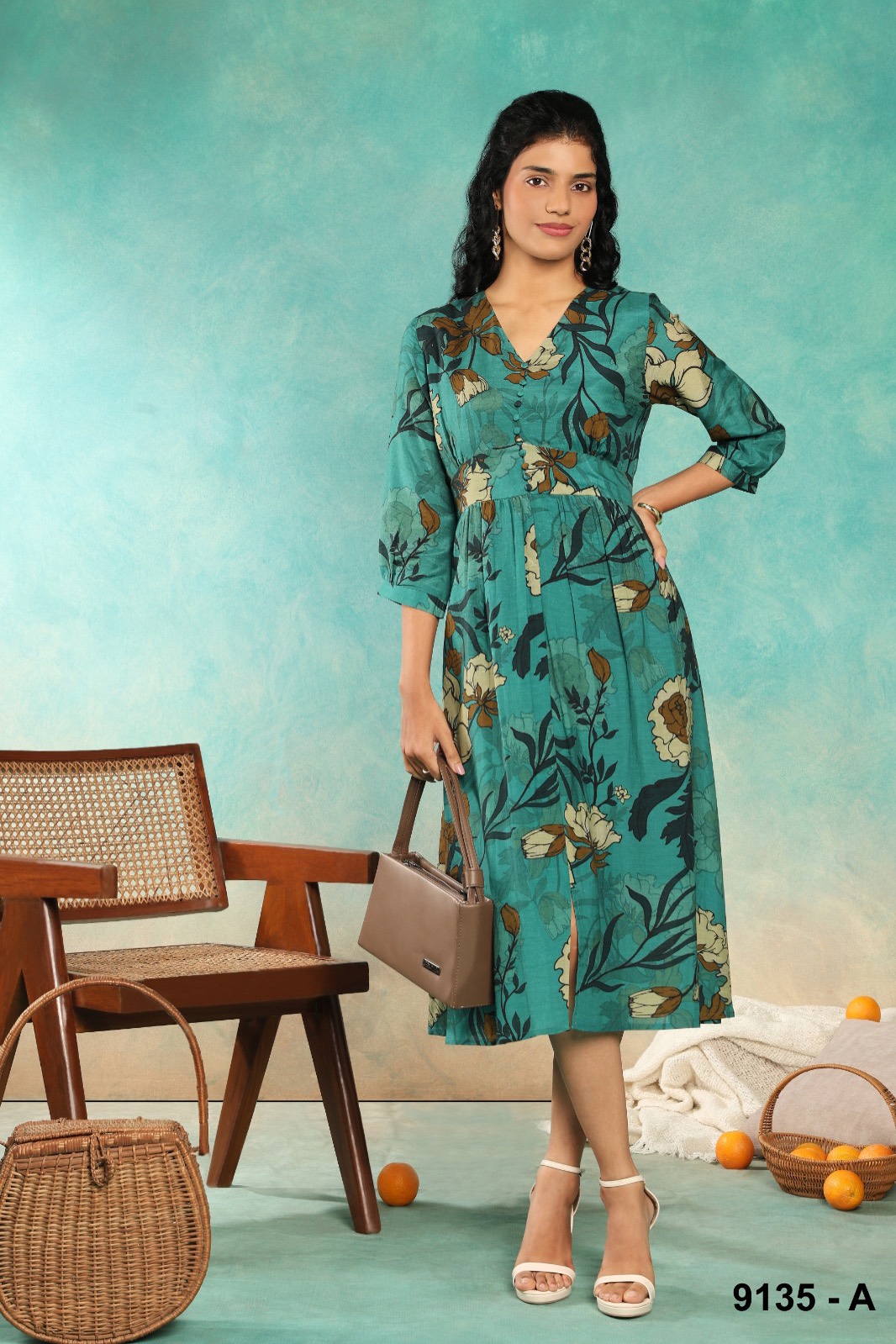
A structured bag — firm sides, a clear rectangle — adds order to soft or printed dresses, as in the teal floral midi here. A slouchy or woven bag relaxes a tailored dress. Scale matters: a small bag looks dressier, a large tote more practical.
Belts
A belt redraws the waist and turns a straight dress into a defined one. Narrow belts read refined; wide belts read bold. Belt shirt dresses, shifts and kaftan shapes; leave already-shaped wrap and fit-and-flare dresses alone unless the belt is very fine.
Scarves
A silk square at the neck adds colour near the face to a plain dress; knotted to a bag handle, it adds an accent without changing the neckline. In air-conditioned offices a light stole doubles as warmth.
Watches
A watch is jewellery you use. A slim leather strap suits daywear and three-quarter sleeves; a metal bracelet watch can stand in for a bangle in the evening. Let it be the only piece on that wrist.
Layering — one dress, many temperatures
A layer changes a dress more quickly than any accessory: it alters the shoulder line, the length of visible fabric and the formality in one move. In Mumbai, layers are often less about cold outside than about air-conditioning inside — offices, cinemas and restaurants — so the best ones are light, packable and easy to remove. The key proportion: a cropped or short layer works with any length; a long layer works best over a dress of similar or longer length.
- 8.1
Jackets
Cropped jackets end at the waist and preserve the shape of fitted dresses. Choose them for fit-and-flare and A-line silhouettes, where hiding the waist would lose the outline.
- 8.2
Shrugs
A shrug covers only the shoulders and upper arms. It is the gentlest way to add sleeves to a sleeveless or strappy evening dress without altering its front view.
- 8.3
Cardigans
Fine knit cardigans soften a dress and make it feel relaxed. Wear them open over midis, or buttoned and belted over a slip dress for a neat, knitted bodice effect.
- 8.4
Denim jackets
The most useful casual layer. A denim jacket instantly makes a floral or satin dress daytime-friendly. Keep it fitted or slightly cropped so the dress stays visible.
- 8.5
Blazers
A blazer brings structure to soft dresses and turns them into workwear. A longer, relaxed blazer suits shift and shirt dresses; a fitted one suits knee-length sheaths.
- 8.6
Kimonos
Long, unstructured and light, a kimono layer flows with maxi and midi dresses. Pair a printed kimono with a plain dress, or a plain one over a print, but rarely print on print.
For the cotton and linen dresses that do most of the work on ordinary days, the everyday dresses guide covers easy layering through the seasons.
Building a versatile wardrobe — formulas
A versatile wardrobe is not about owning many dresses but about owning dresses that combine. Think in roles. A shirt dress or a plain knee-length dress is your structural piece: it takes blazers, trainers, belts and heels with equal ease. A midi in a print is your character piece, carrying an outfit on its own. A satin or crepe dress is your evening piece, but it can be dressed down with knitwear. A maxi covers holidays, festive days and long weekends. Around them, a short list of layers, two or three pairs of shoes and a few bags do most of the work.
Write your own formulas by changing one element at a time. Here are eight to start with:
- F01 Black shirt dress +plus white trainers +plus canvas tote =equals Errands and coffee
- F02 Same black shirt dress +plus block heels +plus gold hoops =equals Dinner with friends
- F03 Navy belted shirt dress +plus loafers +plus structured handbag +plus slim watch =equals Office and meetings
- F04 Floral midi +plus denim jacket +plus flat sandals =equals Weekend lunch
- F05 Same floral midi +plus nude heels +plus pearl studs +plus clutch =equals Family celebration
- F06 Plain knee-length dress +plus tailored blazer +plus pointed flats =equals Presentation day
- F07 Satin slip midi +plus fine knit cardigan +plus ankle-strap sandals =equals Evening plans that start at work
- F08 Printed maxi +plus kimono layer +plus woven bag +plus flat sandals =equals A holiday or a long day outdoors
Notice how formulas F01 and F02 use the same dress, as do F04 and F05: only the shoes, jewellery and bag change, yet the occasion shifts completely. That is the real return on styling knowledge. Before buying something new, ask whether it completes at least three formulas with pieces you already own.
Ready to explore more? Browse the dress styles, plan an evening with the party and evening wear guide, or read about Building a Versatile Women's Dress Wardrobe. Options Mall in Vile Parle West, Mumbai, is always glad to talk through women's fashion in Mumbai — get in touch.