
Women's Dresses in Mumbai
From a cotton shirt dress for a Tuesday commute to floor-length satin for a reception, the dress covers more ground than any other garment in a wardrobe.
This register sorts women's dresses into eight families — by mood, by occasion and, most usefully, by length — and explains what defines each one: the fabrics, necklines, construction and styling that separate a western dress from a party dress, a midi from a maxi. Options Mall in Vile Parle West has written it as a standalone reference to ladies' dresses in Mumbai.
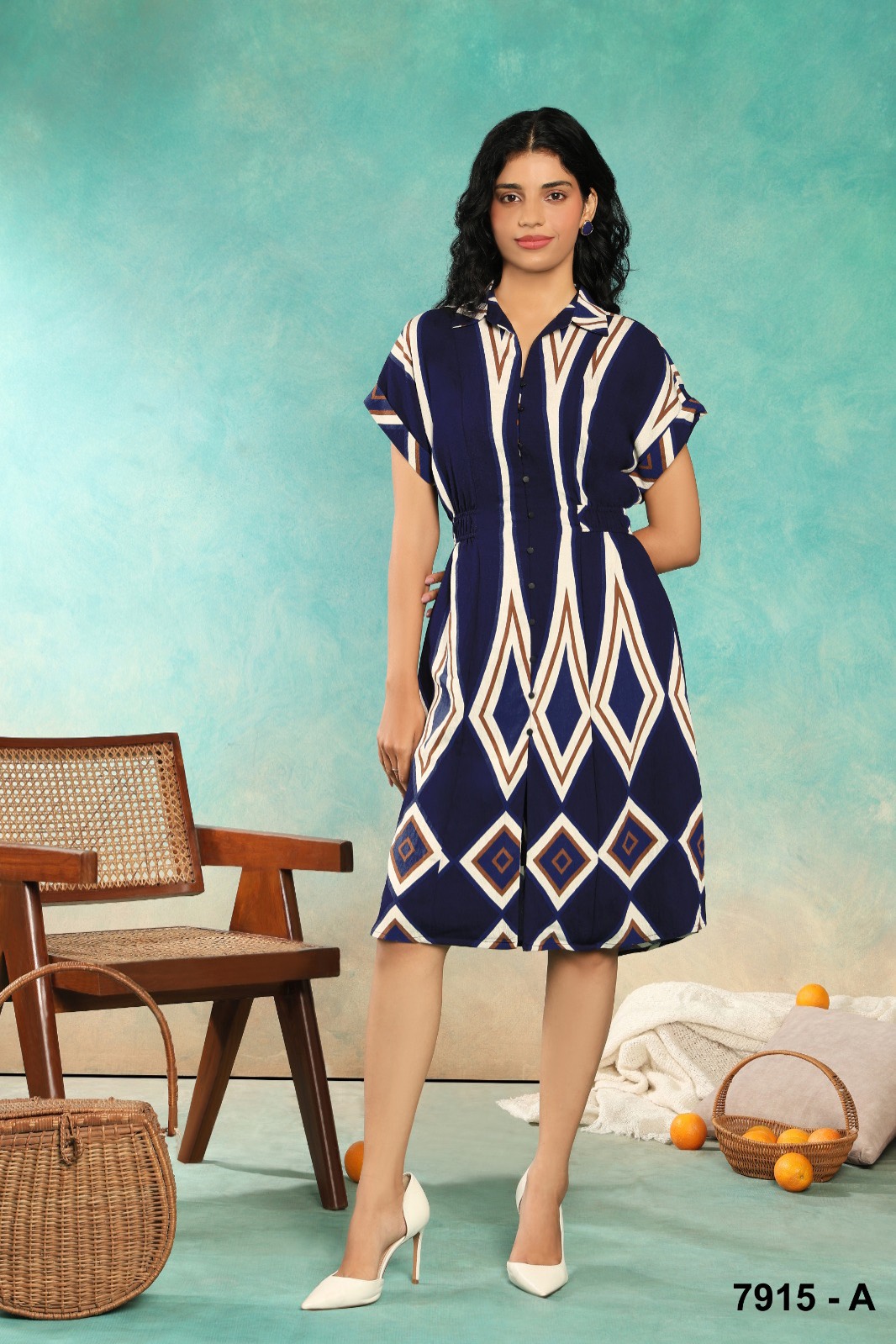
A geometric shirt dress cinched at the waist. Collar, button placket and an easy skirt that stops at the knee.
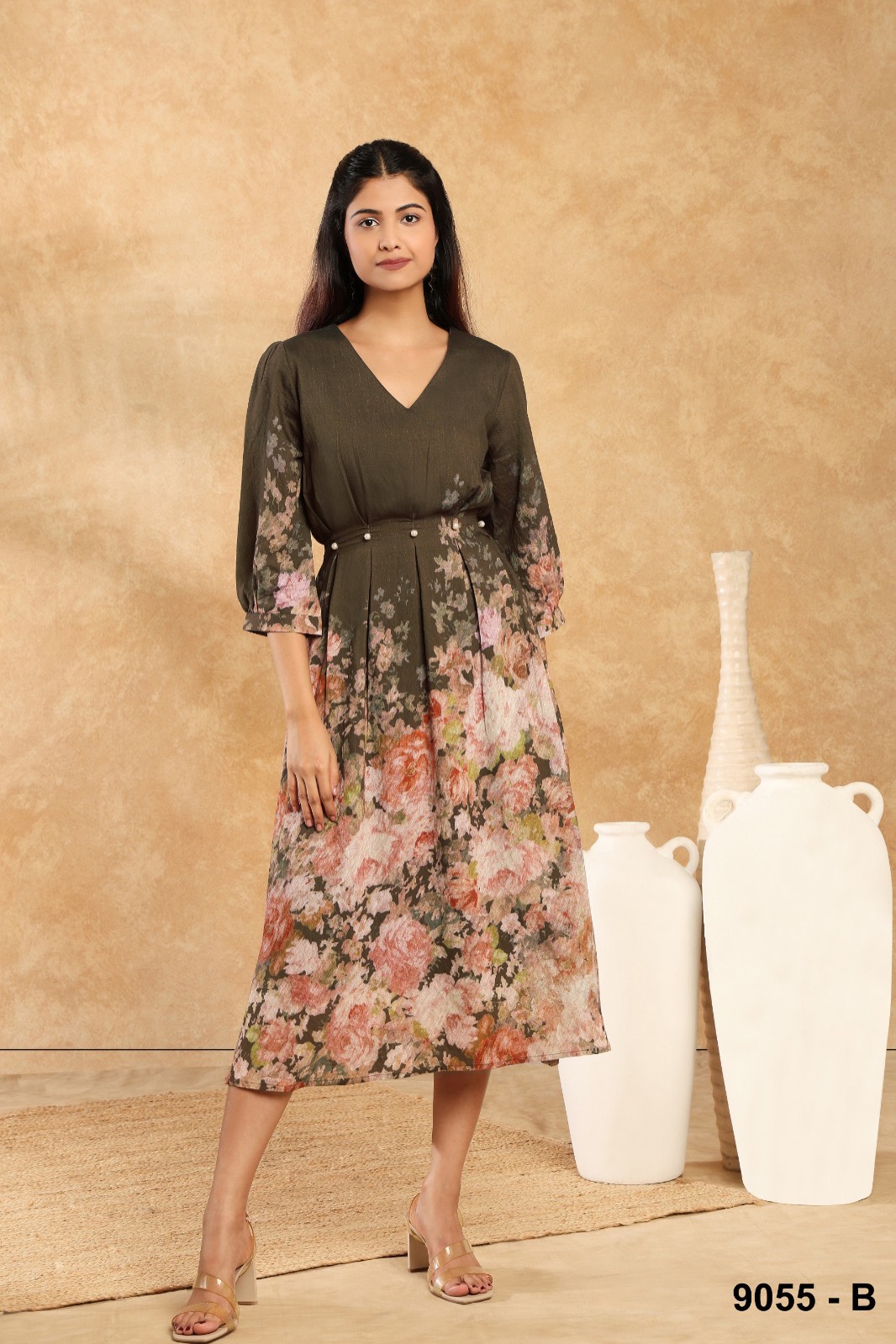
An olive bodice released into a pleated floral skirt whose print deepens towards the hem.
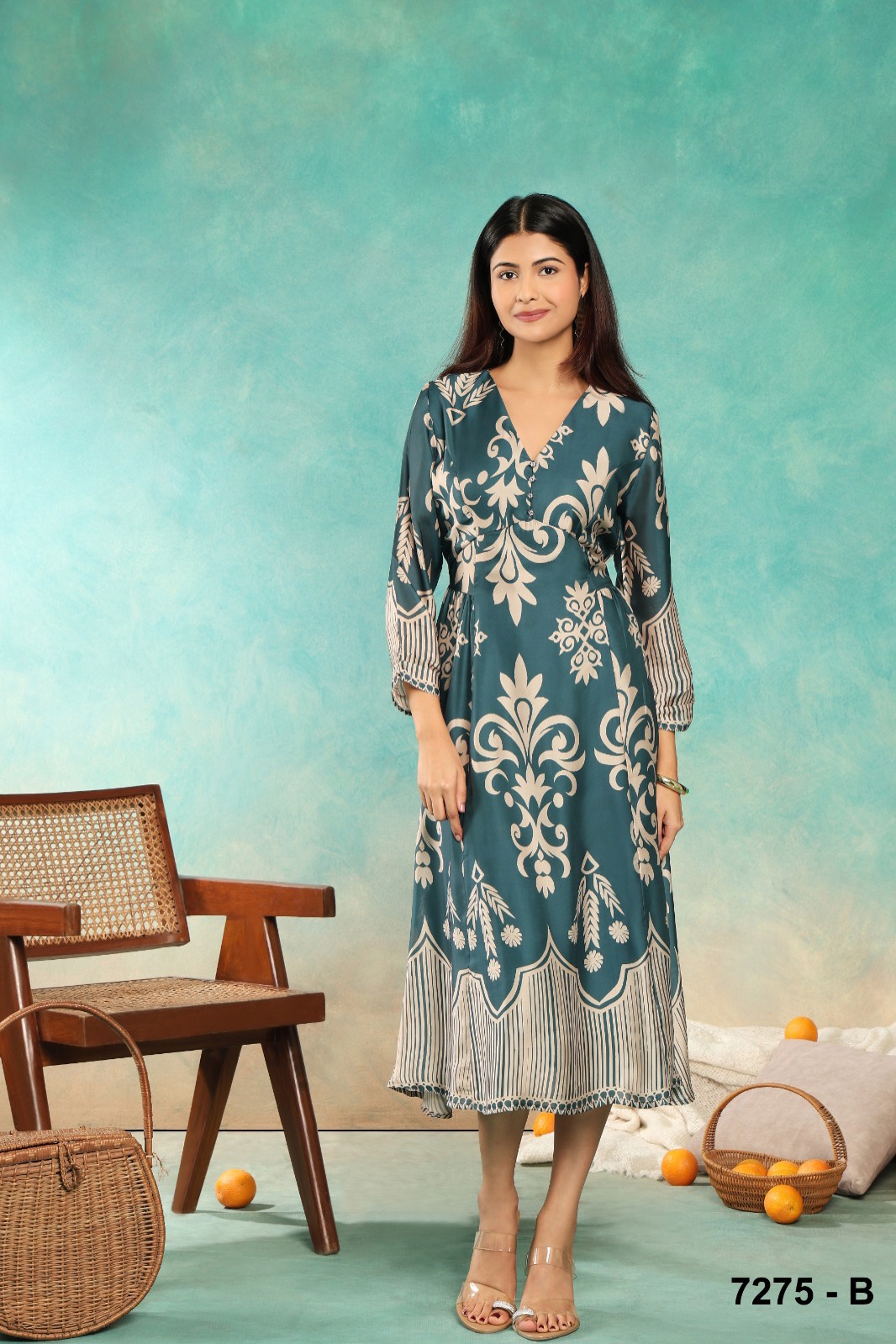
A long-sleeved teal print with an ornamental border placed round the lower skirt — length used as a canvas.
Register 01 / Western
Western dresses for women
Tailored one-piece dresses whose shape is built from seams, darts and collars.
- Length
- Above the knee to the ankle; most often knee and midi
- Typical fabrics
- Cotton poplin, crepe, viscose, georgette, satin
- Neckline / sleeve
- Shirt collars, V-necks and wrap fronts; cap to full-length sleeves
- Mood
- Tailored, versatile, quietly polished
In Mumbai, “Western dresses” is the everyday shorthand for a one-piece garment cut on global tailoring principles rather than on the draped and layered traditions of Indian dress. The distinction matters because it explains how these dresses are made: their shape comes from seams, darts, collars and waistlines, so a single length of cloth is engineered to follow the body from shoulder to hem. The shirt dress, the wrap, the shift and the sheath all belong to this family, and between them they cover a surprising amount of a working week.
What unites western dresses for women is structure you can read at a glance. A shirt dress borrows its collar, placket and cuffs from shirting; a wrap dress relies on one panel crossing the other and tying at the waist; a sheath is shaped close through long vertical darts. Because the line is built in, these dresses need very little styling to look finished — a belt, block heels or flat sandals, a structured bag.
They are also the easiest place to begin if you are building a dress wardrobe from scratch. A well-cut western dress in a mid-weight fabric moves from office to lunch to an early dinner without changing anything but shoes. To see each of these shapes drawn and explained, turn to the silhouette atlas; to understand why the same cut behaves so differently in crepe and in cotton, the material library goes deeper.
Register 02 / Casual
Casual dresses for women
Breathable, forgiving dresses for long days, commutes and humid afternoons.
- Length
- Knee to ankle, with midi the favourite
- Typical fabrics
- Cotton, linen, cotton-linen blends, rayon, chambray
- Neckline / sleeve
- Round, square, V and shirt collars; sleeveless, short or elbow sleeves
- Mood
- Easy, breathable, unfussy
A casual dress is judged by how it feels at four in the afternoon, not by how it looks on a hanger. In a city where humidity stays high for much of the year and the monsoon brings months of damp, the most useful casual dresses for women are the ones that breathe, dry quickly and forgive a long commute. That points to natural and semi-natural fibres — cotton, linen, rayon and their blends — woven loosely enough to let air move through the cloth.
Cut matters as much as cloth. Casual dresses tend to release the body rather than hold it: A-line and shift shapes, smocked or elasticated waists, gathered tiers and relaxed shirt dresses all leave room to sit, walk and reach. Details are practical rather than decorative — in-seam pockets, button fronts, adjustable ties, sleeves that can be rolled. Prints are usually small florals, checks, stripes and block-print-inspired motifs that hide the creases of a busy day.
The best casual dress is also a base layer. Add a denim or linen overshirt for an air-conditioned office, swap sneakers for kolhapuri-style flats, or belt it for a little more definition at the waist. Our everyday dresses chapter explores cotton, linen and printed day dresses in detail, with notes on comfort through Mumbai's seasons.
Register 03 / Party
Party dresses, after dark
Light-catching surfaces, livelier hems and one confident focal point.
- Length
- Mid-thigh to mid-calf
- Typical fabrics
- Satin, sequinned georgette, velvet, metallic knits, crepe
- Neckline / sleeve
- One-shoulder, halter, sweetheart, square; flutter sleeves or straps
- Mood
- Celebratory, lively, light-catching
Party dresses are designed for a particular set of conditions: low or changing light, music, movement, and a room full of people seen at close range. Everything about them answers that brief. Surfaces reflect — satin, sequins, metallic threads, lustrous crepe — so the dress catches light every time you turn. Hems usually sit between mid-thigh and mid-calf, because shorter lengths are easier to dance in and they put the focus on shape and footwear.
Silhouettes lean towards definition. Bodycon and sheath shapes trace the line closely; fit-and-flare and skater cuts add swing to the skirt; one-shoulder, halter and off-shoulder necklines create a single strong gesture at the top of the body. Colour tends to be confident — jewel tones, deep plum, emerald, black with a sheen — or a single tone in a fabric that does the talking.
The key decision is usually where to put the drama. A sequinned dress rarely needs statement jewellery; a plain satin slip can carry bold earrings and a sculptural heel. Choose one focal point and let everything else support it. For a closer look at party wear in Mumbai — satin, sequins, necklines and accessory coordination — continue to the party and evening chapter.
Register 04 / Evening
Evening dresses, long light
Longer lines, fluid fabrics and refined necklines for slower, grander hours.
- Length
- Mid-calf to floor
- Typical fabrics
- Silk, satin, chiffon, georgette, velvet, crepe-back satin
- Neckline / sleeve
- Cowl, deep V, one-shoulder, boat; long or sheer sleeves
- Mood
- Composed, fluid, unhurried
Where a party dress is built for movement, an evening dress is built for presence. Evening occasions — formal dinners, receptions, a long celebration that starts at eight and ends well past midnight — tend to move at a slower pace, and their dresses follow suit. Lengths drop to mid-calf, ankle or floor; fabrics become more fluid, so the skirt falls in long vertical folds and moves a beat after you do.
The craft of evening wear is largely about drape and finish. Bias-cut satin skims the body because the cloth is cut diagonally across the grain; a cowl neckline is simply surplus fabric allowed to fall in soft folds; chiffon and georgette are layered over linings so that the outer veil seems to float. Linings, neat hems and invisible zips are part of the look, because in low light and a still pose every seam is noticed.
Colour usually deepens — wine, midnight, forest, black, champagne — and accessories tighten: one considered piece of jewellery, a small clutch, a heel you can actually stand in for an evening. Our party and evening guide breaks down evening necklines, lengths and colour in detail, and the occasion chapter covers formal invitations.
Register 05 / Midi
Midi dresses for women
The adaptable length: below the knee, above the ankle.
- Length
- Just below the knee to mid-calf
- Typical fabrics
- Crepe, viscose, cotton, georgette, satin, linen
- Neckline / sleeve
- Every type — V, square, wrap, collar; elbow and three-quarter sleeves
- Mood
- Adaptable, considered, modern
The midi is defined by where it ends: somewhere between just below the knee and the middle of the calf. That band of length is the reason midi dresses for women have become the most adaptable length in a contemporary wardrobe. Long enough to feel composed at work or at a family gathering, short enough to walk briskly, climb stairs and step on and off a local train without gathering up the hem.
Because the hem lands on the lower leg, the midi is unusually responsive to footwear and proportion. A pointed flat extends the line; a block heel adds lift without changing the mood; ankle-strap sandals draw attention to the strip of leg between hem and shoe. The same midi also reads differently in different fabrics — in cotton it is a day dress, while in satin or crepe it steps comfortably into the evening.
Almost every silhouette exists at midi length: A-line, fit-and-flare, wrap, pleated, tiered and slip shapes all work well here. The ombré floral in our register is a good example — a plain olive bodice, a pleated waist and a skirt whose print grows richer towards the hem, so the eye travels downward to the length itself.
The Versatility of Midi DressesThe midi on the silhouette atlas
Register 06 / Maxi
Maxi dresses for women
One unbroken line from shoulder to ankle or floor.
- Length
- Ankle to floor
- Typical fabrics
- Georgette, chiffon, rayon, cotton voile, satin, jersey
- Neckline / sleeve
- V, halter, off-shoulder, wrap; sleeveless to full balloon sleeves
- Mood
- Sweeping — relaxed by day, dramatic by night
Maxi dresses for women fall to the ankle or the floor, and that unbroken line is their whole character. With no visible break at the knee or calf, the eye reads the figure as a single vertical, which is why a maxi can look effortless at a seaside lunch and commanding at a reception. The difference between those two moods lies almost entirely in fabric and cut.
Day maxis are usually light and airy — cotton voile, rayon, crinkled georgette — with tiered or gathered skirts that create volume without weight. Evening maxis become more fluid and more fitted: satin, crepe and jersey cut close through the bodice and released lower down, sometimes with a slit for walking room. Long-line printed dresses, like the teal piece in our register with its ornamental border running round the lower skirt, show how a long hem becomes a canvas for borders, placement prints and colour-blocked panels.
A few practical notes. Check the length with the shoes you intend to wear, because a maxi that skims the floor in heels will drag in flats. Think about stairs, escalators and rain — through Mumbai's monsoon, a hem that clears the ankle is the wiser everyday choice.
Exploring Contemporary Maxi Dress StylesThe maxi on the silhouette atlas
Register 07 / Short
Short dresses
Above the knee, where every decision of cut shows.
- Length
- Mid-thigh to the knee
- Typical fabrics
- Cotton, denim, crepe, scuba, satin, textured weaves
- Neckline / sleeve
- Shirt collars, square, crew, halter; short or puff sleeves
- Mood
- Light, spirited, graphic
Short dresses end at or above the knee, anywhere from mid-thigh to the kneecap. Because there is less fabric, every decision shows: the cut of the shoulder, the placement of the waist, the scale of a print. A short dress is therefore one of the most graphic garments in a wardrobe — it reads almost as a single shape set against the legs.
The two dominant families are the structured and the swinging. Structured short dresses — shift, sheath, shirt dress and bodycon — rely on a clean outline and look sharpest in fabrics with some body, such as crepe, cotton twill or scuba. Swinging short dresses — skater, fit-and-flare, tiered and A-line — introduce movement at the hem and suit lighter weaves. The geometric shirt dress in our register sits between the two: collar and button front from the structured side, a cinched waist and an easy skirt from the other.
Proportion is the main styling lever. With more leg visible, footwear becomes a larger share of the overall look — a pointed heel lengthens, a chunky sneaker grounds, a flat sandal keeps things casual. Layering is the second lever: a long blazer or shirt-jacket worn open over a short dress changes its occasion entirely.
Lengths & footwear in the styling guideThe shift, plate by plate
Register 08 / Contemporary
Contemporary dresses, rethought
Asymmetry, layering and cut used as ornament.
- Length
- Any — often uneven, high–low or pointed
- Typical fabrics
- Crepe, organza, poplin, technical blends, mixed textures
- Neckline / sleeve
- One-shoulder, cut-outs, cowls; sculpted or detached sleeves
- Mood
- Experimental, architectural, personal
Contemporary women's dresses are less a single shape than an attitude towards the dress itself. Designers working in this space take a familiar garment and question one of its assumptions — that a hem should be level, that a neckline should be symmetrical, that a dress should be a single layer. The results are asymmetric hems, one-shoulder necklines, handkerchief points, cut-outs, deconstructed shirting and dresses worn over trousers or beneath sheer overlayers.
Several influences meet here. Japanese and Belgian design brought volume that stands away from the body and seams that are allowed to show. Minimalism contributed clean, unadorned surfaces where the cut is the only decoration. Streetwear introduced utility details, mixed fabrics and an ease with layering. And in India, the long tradition of drape — the way a sari or dupatta travels across the body — continues to inform wrapped and asymmetric constructions.
Wearing a contemporary dress well is mostly a matter of restraint elsewhere. If the dress carries a sculptural sleeve or an angled hem, keep accessories quiet and let the silhouette speak. These pieces also layer beautifully: a slip dress over a fine knit, a shirt dress worn open over wide trousers, an asymmetric tunic-length dress over slim pants.
Asymmetric & one-shoulder on the atlasUnderstanding Contemporary Women's Dress Fashion
Length against occasion
Length is the quickest way to narrow a choice. Read across a row to see where each hemline sits most naturally; fabric and silhouette then do the fine-tuning. These are conventions, not rules — a short dress in black crepe can be formal, and a cotton maxi can be the easiest thing you wear all week.
| Length | Everyday | Work | Social daytime | Party | Evening & formal | Celebrations |
|---|---|---|---|---|---|---|
| ShortAbove the knee | Natural fit — cotton, denim, shirt dresses | Depends on the dress code; layer a long blazer | Yes, especially printed and A-line shapes | The classic choice — sequins, satin, bodycon | Less usual; choose structure and a dark tone | Relaxed parties and birthdays |
| KneeAt the kneecap | Shirt and shift dresses | A strong choice — sheath, shirt, wrap | Yes, in almost any silhouette | Fit-and-flare, satin, one-shoulder | Cocktail hours and early dinners | Yes, in a richer fabric |
| MidiBelow knee to mid-calf | Cotton and viscose day dresses | A strong choice in crepe or knit | Ideal — wrap, floral, pleated | Satin, or a slit for movement | Fluid fabrics and deeper colour | Ideal for family functions and dinners |
| MaxiAnkle length | Light cottons and tiered rayon | Selectively; keep the line streamlined | Brunches, holidays, daytime functions | Fitted shapes or a side slit | A strong choice | Festive prints and belted silhouettes |
| FloorSkims the floor | Rarely practical on city streets | Not typical | Resort and garden settings | Gala-style parties | The classic gown length | Formal receptions |
From family to fit
The register tells you which kind of dress you are looking at. The next two chapters tell you how to wear it and how it is shaped.
- 08The styling guideNecklines, sleeves, lengths, footwear, colour and layering — a field manual for wearing every dress on this page.
- 03Dress styles & silhouettesFifteen silhouettes drawn as technical plates, from A-line and wrap to sheath, empire and asymmetric.
Also in the guide: occasion and celebration dresses · fabrics and construction · visit Options Mall, Vile Parle West